
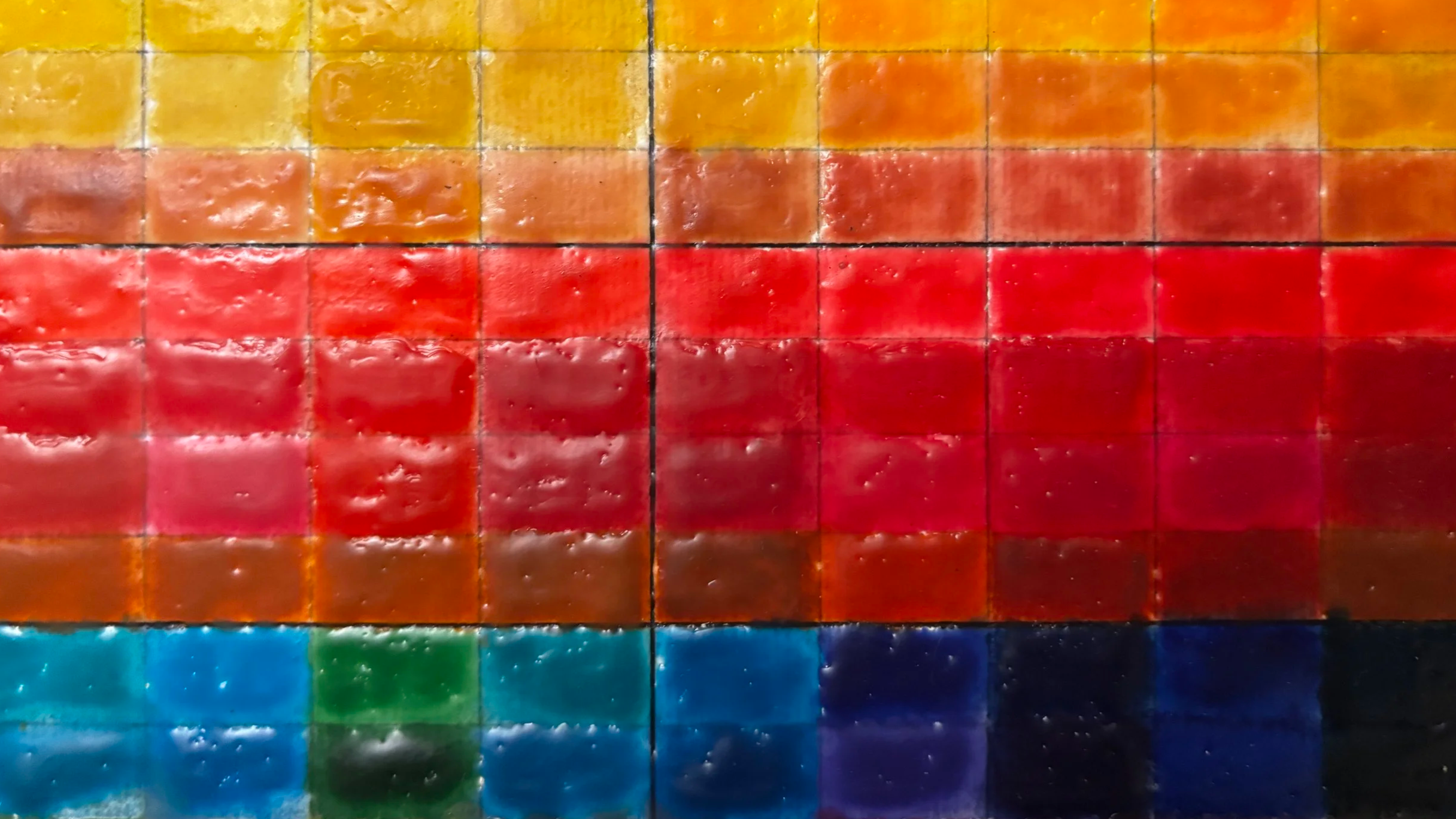
I’ve been taking a deep dive into the world of color mixing. One of the difficulties in color mixing, especially for encaustic paint, is that too much mixing can leave you with a muddy mess. Identifying your translucency vs opacity goals are also important in your color mixes. Since some encaustic techniques rely on translucency or opacity to be successful, your color mixing choices can impact your piece even before you’ve put any paint on your substrate. I’ve learned a lot from watercolor artist, Jeanne Dobie and her book Making Color Sing. Her focus was of course, watercolor, but the principles remain the same no matter what the medium. Her mantra: only mix colors that are transparent and are single pigment. I identified 22 encaustic paints from the R&F and Enkaustikos paint lines that fit that criteria (well….really 21 colors. One of the colors is semi-transparent, but I included it anyway.) Twenty-two colors is a fraction of the 210 paint colors available in both companies’ paint lines, but with color mixing, you can create 484 colors! (And countless more if you consider variations of those colors….) I’ve been working on a color “recipe chart” as a reference (see detail pictured above) and I can’t wait to use it when I work on my next piece! I’m hoping to incorporate what I’ve learned about color mixing into one of my classes. Stay tuned….
Speaking of classes, I’ve set my teaching schedule at the TMA studio, so if you’re interested, click here to see the dates and descriptions. Hope to see you at some (or all!) of them!!
Happy holidays and see you in the New Year!!
~Gina